

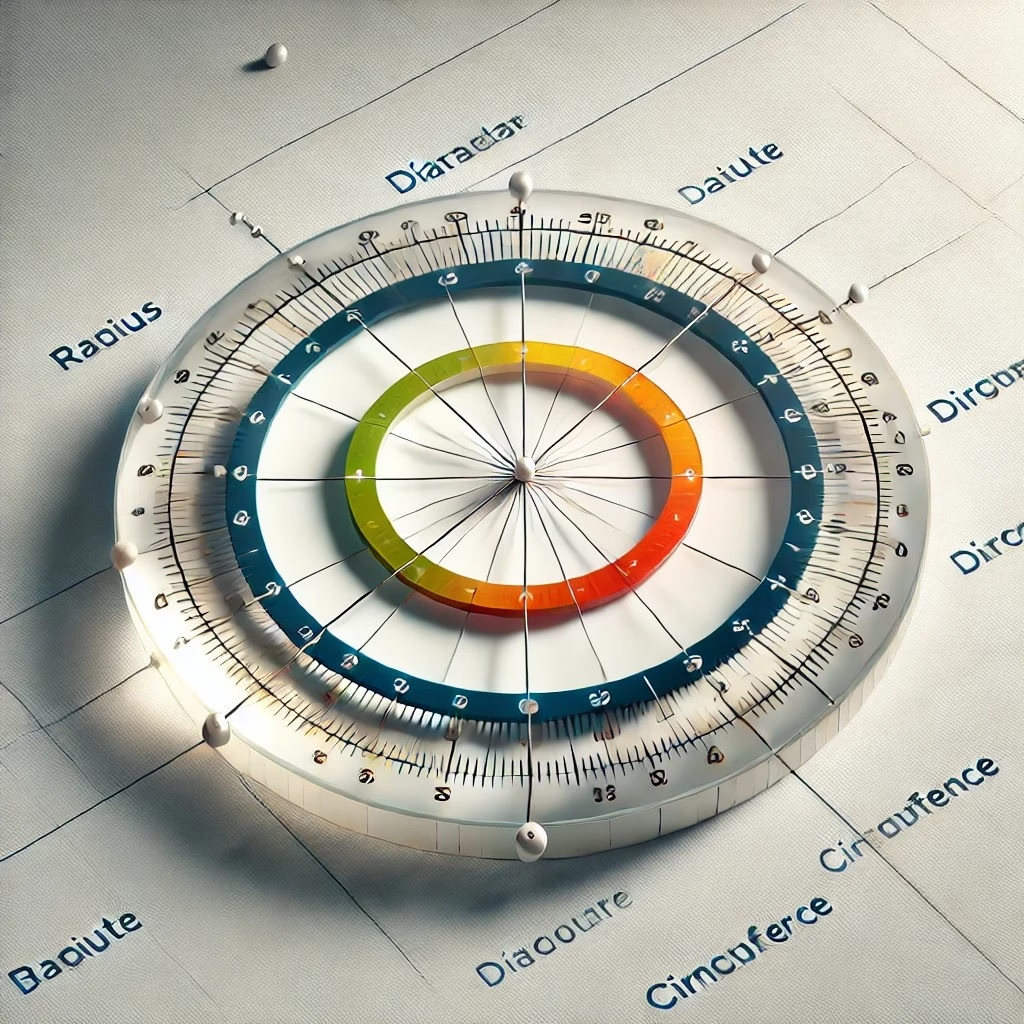
Circumference is one of the most important concepts in geometry. It describes the distance around a circle, just as perimeter describes the distance around a polygon. When students learn about circumference, they begin to understand how radius, diameter, and mathematical constants work together to describe circular shapes.
Whether you are measuring a bicycle wheel, calculating the length of a circular track, designing a round table, or studying the size of planets, circumference is a useful and practical idea. In this lesson, we will explain the circumference formula, show how it relates to radius and diameter, solve example problems, and explore real-world uses of circumference.
What Is Circumference?
The circumference of a circle is the total distance around its outer edge. If you could cut a circle at one point and stretch its curved boundary into a straight line, the length of that line would be the circumference.
In simple terms, circumference is the perimeter of a circle. Since circles do not have straight sides, we use special formulas involving the radius, diameter, and the number \(\pi\), called pi.
The Formula for Circumference
The circumference of a circle can be found in two main ways. The formula you choose depends on whether you know the diameter or the radius.
- Using the diameter: \(C = \pi d\)
- Using the radius: \(C = 2\pi r\)
Where:
- \(C\) represents the circumference,
- \(\pi\) is approximately \(3.14159\),
- \(d\) represents the diameter,
- \(r\) represents the radius.
The radius is the distance from the center of a circle to any point on the circle. The diameter is the distance across the circle through its center. Since the diameter is twice the radius, we can write:
\(d = 2r\)
That is why the two circumference formulas are really connected. If \(C = \pi d\) and \(d = 2r\), then \(C = 2\pi r\).
Why Pi Matters in Circumference
Pi, written as \(\pi\), is the constant ratio between a circle’s circumference and its diameter. No matter how large or small a circle is, this ratio stays the same:
\(\pi = \frac{C}{d}\)
This means that if you divide the circumference of any circle by its diameter, the result will always be approximately \(3.14159\). Pi is an irrational number, which means its decimal form continues forever without repeating. For most school problems, students use \(3.14\) or the \(\pi\) button on a calculator.
Visualizing Circumference
The diagram below shows the relationship between a circle’s radius, diameter, and circumference.
In the diagram, the green line represents the diameter because it crosses the entire circle through the center. The red line represents the radius because it goes from the center to the edge. The blue curved boundary represents the circumference.
Properties of Circumference
Circumference has several important properties that help students understand circles more clearly.
- Circumference increases as the circle gets larger. A circle with a larger radius or diameter will always have a larger circumference.
- Circumference is proportional to diameter. If the diameter doubles, the circumference also doubles.
- The ratio between circumference and diameter is always pi. This is true for every circle, from a small coin to a large planet.
- The formula works at every scale. The same relationship applies whether the circle is measured in centimeters, meters, miles, or any other unit.
Example 1: Finding Circumference Using Diameter
A circular track has a diameter of 50 meters. What is its circumference?
Use the formula:
\(C = \pi d\)
Substitute the diameter:
\(C = \pi \times 50\)
Using \(\pi \approx 3.14159\):
\(C \approx 3.14159 \times 50 = 157.08\)
The circumference is approximately 157.08 meters.
Example 2: Finding Circumference Using Radius
A bicycle wheel has a radius of 35 centimeters. How far will the bicycle travel in one complete wheel rotation?
Use the formula:
\(C = 2\pi r\)
Substitute the radius:
\(C = 2\pi(35)\)
Simplify:
\(C = 70\pi\)
Using \(\pi \approx 3.14159\):
\(C \approx 219.91\)
The wheel travels approximately 219.91 centimeters in one complete rotation.
Example 3: Finding the Radius From Circumference
The circumference of a circular pool is 31.4 meters. What is its radius?
Start with the circumference formula:
\(C = 2\pi r\)
Solve for \(r\):
\(r = \frac{C}{2\pi}\)
Substitute the circumference:
\(r = \frac{31.4}{2\pi}\)
Using \(\pi \approx 3.14\):
\(r = \frac{31.4}{6.28} = 5\)
The radius of the pool is 5 meters.
Comparing Circumferences
When the radius of a circle changes, the circumference changes in the same proportion. The example below compares two circles. The larger circle has twice the radius of the smaller circle, so its circumference is also twice as large.
\(C = 2\pi r = 2\pi(50) = 100\pi \approx 314.16\)
\(C = 2\pi r = 2\pi(100) = 200\pi \approx 628.32\)
This comparison shows an important rule: if the radius doubles, the circumference doubles. If the radius triples, the circumference triples. This is because circumference is directly proportional to radius.
Real-Life Applications of Circumference
Circumference is not just a classroom topic. It appears in many real-world situations, especially when people need to measure or design circular objects.
- Engineering and design: Engineers use circumference to design wheels, gears, pipes, and circular machine parts.
- Transportation: The circumference of a tire helps determine how far a vehicle moves with each wheel rotation.
- Sports and fitness: Circular tracks, running paths, and exercise equipment often require circumference calculations.
- Architecture: Builders use circumference when designing domes, arches, round rooms, fountains, and circular structures.
- Astronomy: Scientists use circle measurements to study planets, orbits, and other curved paths in space.
- Geography: Circumference helps explain large-scale measurements, such as the distance around Earth at the equator.
Common Mistakes When Finding Circumference
Students often understand the formula but make small mistakes when applying it. Here are some common errors to avoid:
- Confusing radius and diameter: Remember that the diameter is twice the radius.
- Using the wrong formula: Use \(C = \pi d\) when you know the diameter and \(C = 2\pi r\) when you know the radius.
- Forgetting units: Circumference is a length, so the answer should use units such as centimeters, meters, inches, or miles.
- Rounding too early: For more accurate answers, wait until the final step before rounding.
Practice Problems
Try solving these circumference problems on your own.
- A circle has a diameter of 12 inches. What is its circumference?
- A circle has a radius of 8 centimeters. What is its circumference?
- A circular garden has a circumference of 62.8 meters. What is its radius?
- A wheel has a radius of 14 inches. How far does it travel in one full rotation?
Answers:
- \(C = \pi(12) \approx 37.70\) inches
- \(C = 2\pi(8) \approx 50.27\) centimeters
- \(r = \frac{62.8}{2\pi} \approx 10\) meters
- \(C = 2\pi(14) \approx 87.96\) inches
Frequently Asked Questions About Circumference
What is circumference in simple words?
Circumference is the distance around a circle. It is the circle’s perimeter.
What is the formula for circumference?
The two main formulas are \(C = \pi d\) and \(C = 2\pi r\). Use the first formula when you know the diameter and the second formula when you know the radius.
What is the difference between radius and diameter?
The radius is the distance from the center of the circle to the edge. The diameter is the distance across the circle through the center. The diameter is twice the radius.
Why do we use pi to find circumference?
We use pi because the ratio between a circle’s circumference and diameter is always the same. That constant ratio is \(\pi\).
Conclusion
Circumference is a key idea in geometry because it helps us measure the distance around a circle. By understanding the relationship between radius, diameter, and pi, students can solve many types of circle problems with confidence.
The most important formulas to remember are \(C = \pi d\) and \(C = 2\pi r\). These formulas are useful not only in math class, but also in engineering, sports, architecture, transportation, astronomy, and everyday life. Once students understand circumference, they are better prepared to study more advanced topics such as area, volume, trigonometry, and circular motion.

